
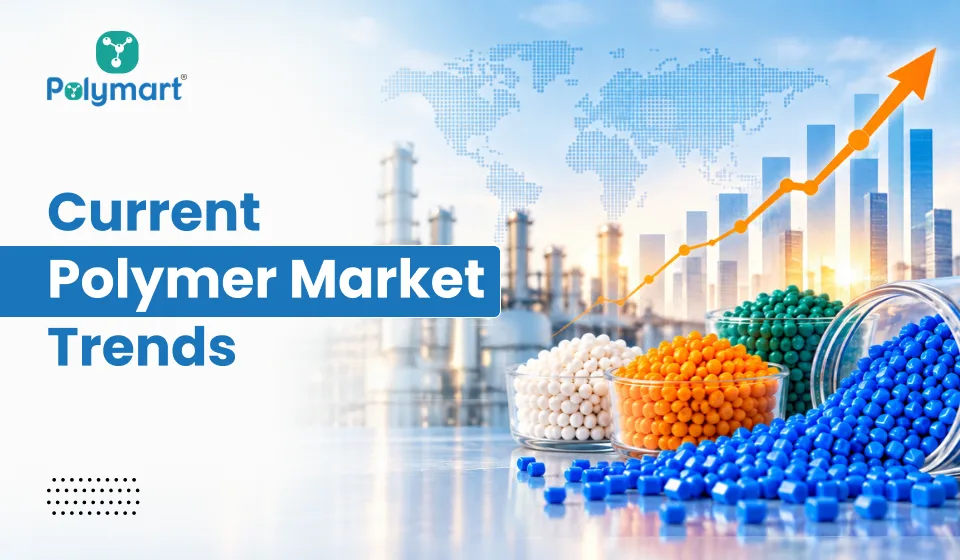
The polymer market is shifting as changing demand, raw material costs, production capacity, and global trade continue to influence prices and supply. From PP, HDPE, LDPE, LLDPE, PVC, and PET trends to evolving market demand, businesses are closely watching these changes to make better sourcing and inventory decisions.
Understanding the latest Polymer Market Trends can help manufacturers, distributors, and buyers respond to price movements, supply disruptions, and changing market demand.
TL;DR
- Polymer prices are volatile, with feedstock costs, production changes, and geopolitical disruptions influencing Polymer Price Trends.
- Polymer demand trends are uneven, with PP, PE, PVC, and PET demand varying by region, application, and downstream industry.
- Polymer supply trends are changing, as new production capacity and shifting trade flows reshape regional availability.
- Geopolitical risks are affecting polymers, particularly through energy prices, shipping disruptions, and changes in global petrochemical supply.
- Recycled and circular polymers are gaining importance, while businesses increasingly monitor the Global Polymer Market Outlook to manage sourcing and pricing decisions.
Key Factors Influencing Current Trends in the Polymer Market
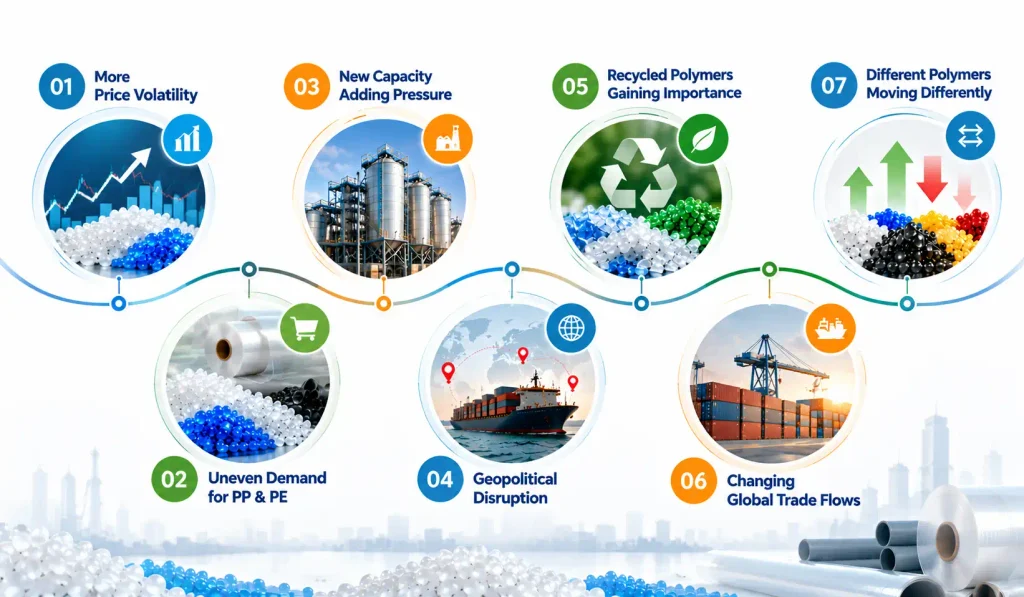
The Current Polymer Market Trends in 2026 show a market dealing with uneven demand, regional supply constraints, volatile feedstock costs, and continued changes in global trade flows. Recent pricing data also shows that polymer markets are not moving uniformly, some grades are strengthening while others remain under pressure.
1. Polymer prices are becoming more volatile
Polymer Price Trends remain closely linked to crude oil, petrochemical feedstocks, production costs, and logistics. In September 2026, domestic polymer prices for PP, HDPE, LLDPE, and LDPE were revised upward several times, before buyers pushed back against higher replacement costs.
This means buyers are increasingly monitoring polymer resin prices rather than relying on fixed purchasing cycles.
2. PP and PE markets are showing uneven demand
PP and PE market trends vary across different regions. While supply constraints and higher costs have supported prices in some markets, downstream demand remains cautious. ICIS reported in September that buyers across the GCC, Europe, and India were largely purchasing only for immediate requirements rather than building large inventories.
This cautious buying pattern is an important part of current Polymer Demand Trends.
3. New capacity is keeping pressure on some polymer grades
Not every polymer is experiencing tight supply. New production capacity, particularly in parts of Asia, continues to weigh on some markets. LDPE, for example, has faced pressure from additional capacity alongside weak downstream demand, although production shutdowns in some regions have provided partial support.
As a result, HDPE market trends, LDPE market trends, and LLDPE market trends can differ significantly even within the broader polyethylene market.
4. Geopolitical disruption is reshaping polymer supply chains
The Middle East conflict has become a major influence on Polymer Supply Trends in 2026. Disruptions around the Strait of Hormuz have affected energy and petrochemical flows, increasing concerns around feedstock availability, shipping costs, and delivery reliability.
Recent market data shows that the impact is not uniform: Indian PP and HDPE prices strengthened in early October while PVC and PET moved lower, highlighting how different polymer chains are responding to the same geopolitical environment.
5. Recycled polymers are gaining importance, but unevenly
The shift toward recycled and circular materials continues, but economic conditions are making adoption uneven. S&P Global notes that the 2026 Middle East disruption temporarily increased demand for recycled PE, PP, and PET as buyers looked for alternatives to tighter virgin polymer supplies.
This makes recycled polymers an important part of longer-term Polymer Industry Trends, although their competitiveness still depends heavily on virgin polymer prices, regulations, feedstock availability, and recycling economics.
6. Global polymer trade flows are changing
Supply disruptions are also encouraging buyers and producers to look for alternative sources. For example, ICIS reports that India’s import sources have shifted significantly in 2026, with China becoming a much more important supplier for certain petrochemical products while South Korea and other Asian suppliers have gained relevance.
This broader diversification is becoming an important feature of the Global Polymer Market Outlook, as businesses place greater emphasis on supply security.
7. Different polymers are moving in different directions
One of the clearest Polymer Industry Trends is that there is no single direction for the entire market. September data showed contrasting movements across PP, PE, PVC, PET, and engineering plastics, with regional supply, feedstock costs, and downstream purchasing producing different outcomes.
Therefore, businesses tracking Polypropylene price trends, Polyethylene price trends, PVC, PET, or other grades need to evaluate each polymer and region separately rather than relying on a single overall Polymer Market Outlook.
Conclusion
The Current Polymer Market Trends point toward a market where price movements, changing demand, supply disruptions, and shifting trade flows can make polymer sourcing more challenging. For buyers and sellers, staying informed and having access to the right market opportunities can make a meaningful difference in day-to-day polymer trading.
PolyMart brings polymer buying and selling together on one digital platform. Buyers can explore available grades, compare location-wise delivered prices, send inquiries, and manage orders, while sellers can list their polymer stock and connect with an active network of buyers.
Whether you want to buy polymers for your manufacturing needs or sell polymers to move available or excess inventory, PolyMart helps simplify the process with digital tools, market information, and support across procurement and fulfillment.
Download it here for free today.
Frequently Asked Questions(FAQs)
What is PolyMart?
PolyMart is a digital polymer marketplace that connects buyers and sellers of polymers. It helps businesses explore polymer products, check available offers and delivered prices, send inquiries, and manage polymer buying or selling through one platform.
Which polymers are in highest demand?
PP, HDPE, LLDPE, LDPE, PVC, and PET remain widely used across packaging, construction, automotive, healthcare, consumer goods, and other industries. Actual demand varies by application, region, and market conditions, so there is no single polymer that consistently has the highest demand everywhere.
What is the Polymer Market Outlook for 2026?
The Polymer Market Outlook remains mixed, with prices and demand varying by polymer, region, and end-use industry. Feedstock costs, new production capacity, trade flows, and geopolitical developments will continue to influence the market.
What factors influence the Polymer Price Forecast?
A Polymer Price Forecast depends on crude oil and feedstock prices, production capacity, plant shutdowns, inventory levels, import and export activity, freight costs, and downstream demand. Unexpected supply disruptions can also cause short-term price changes.
How can businesses monitor Polymer Price Trends?
Businesses can monitor Polymer Price Trends through regular market updates, industry news, supplier offers, and production reports. PolyMart’s News section provides regular market updates, graphs, and industry insights to help buyers stay informed about polymer price movements and make better sourcing decisions.
How can I find polymers at competitive prices?
Buyers can compare available grades, suppliers, delivered prices, and current offers before purchasing. Platforms such as PolyMart can help buyers explore available polymer options and connect with sellers based on their requirements.
Can PolyMart help with bulk polymer procurement?
Yes. Businesses looking for polymers for manufacturing or other industrial requirements can use PolyMart to explore available products, review offers, submit inquiries, and coordinate their purchasing requirements.