
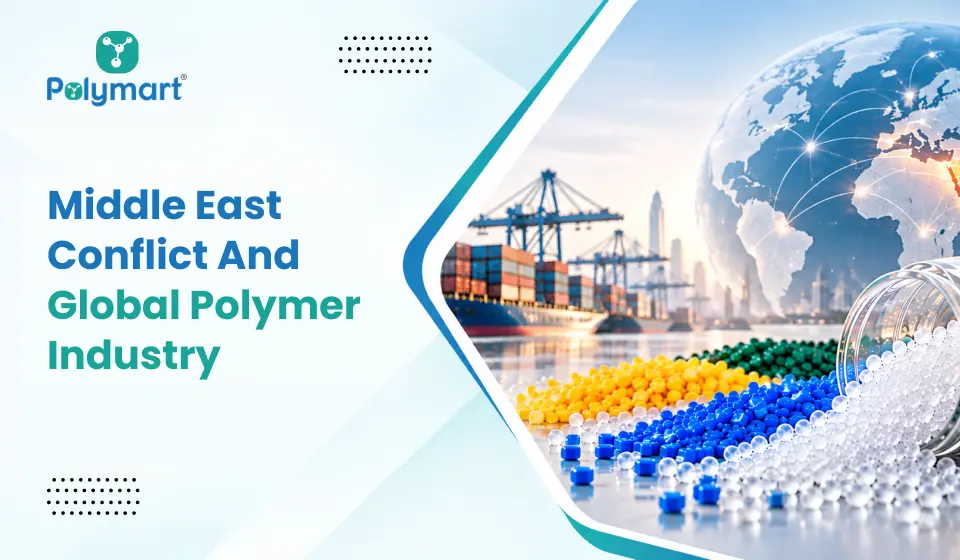
The Middle East conflict has disrupted petrochemical trade, increased shipping risks, and pushed up resin costs across the Global Polymer Industry.
According to Reuters, the Middle East supplied more than 40% of global polyethylene exports in 2025, making regional disruptions significant for polymer buyers worldwide.
The Middle East conflict’s impact on the Global Polymer Industry is also evident in India, where PP raffia prices rose about 55% over seven months from the conflict’s onset, according to BigMint’s October 2026 market analysis.
Understanding these Polymer Supply Chain Disruptions is essential for businesses navigating changing resin prices, material availability, and procurement costs.
TL;DR
- The Middle East conflict disrupts petrochemical production, shipping routes, and resin exports, affecting the Global Polymer Industry.
- Higher feedstock costs, freight charges, and supply constraints can increase Global Polymer Prices and procurement costs.
- PP, HDPE, LDPE, LLDPE, PVC, and PET experience different price and supply changes depending on feedstocks, availability, and demand.
- India faces higher import costs, delivery uncertainty, and price volatility, affecting manufacturers, processors, and distributors.
- Businesses can manage uncertainty by monitoring Polymer Market Prices, diversifying suppliers, planning inventory, and comparing sourcing options through marketplaces such as PolyMart.
Why Is the Middle East So Important to the Global Polymer Industry?
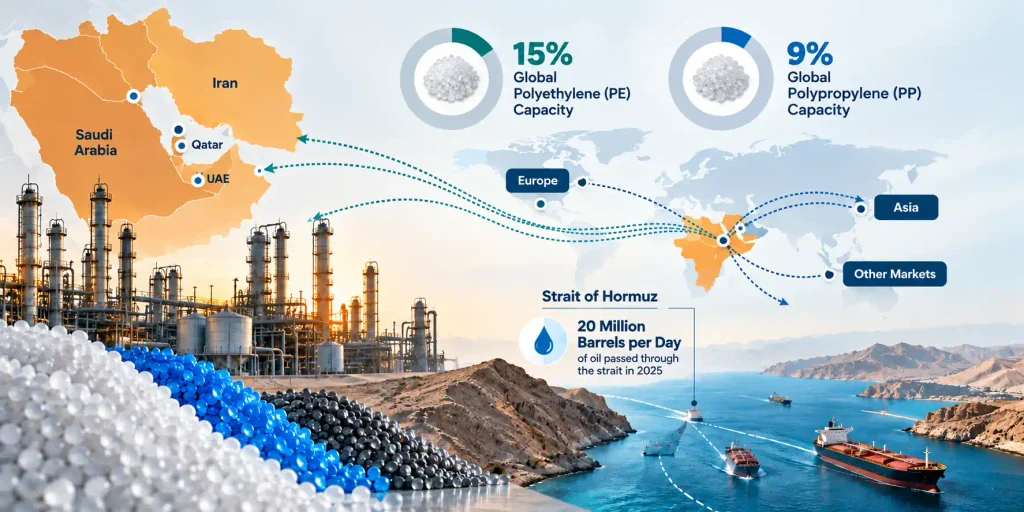
The Middle East plays a major role in the Global Polymer Industry because it combines abundant oil and gas resources with large-scale petrochemical production and export infrastructure. Countries such as Saudi Arabia, the UAE, Qatar, and Iran supply key feedstocks and polymers to manufacturers across Asia, Europe, and other markets.
According to S&P Global, the region accounts for approximately 15% of global polyethylene (PE) capacity and 9% of polypropylene (PP) capacity. This makes disruptions in the region significant for international resin availability and pricing.
The Strait of Hormuz Matters
The Strait of Hormuz is a critical shipping route connecting the Persian Gulf with the Gulf of Oman and the Arabian Sea. The International Energy Agency (IEA) reports that approximately 20 million barrels of oil per day passed through the strait in 2025.
When conflict disrupts shipping through the strait, the effects can extend beyond oil. Polymer exporters may face delays, higher freight and insurance costs, and difficulties delivering resin to customers. These pressures can contribute to Polymer Supply Chain Disruptions and increase uncertainty for manufacturers that depend on consistent raw material supplies.
How Does the Middle East Conflict Disrupt Global Polymer Supply Chains & Affect Prices?
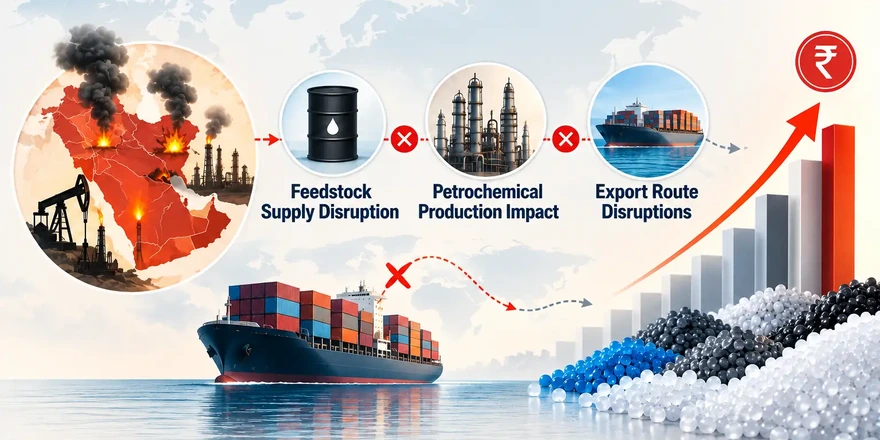
The Middle East Conflict Impact on the global polymer industry goes beyond delayed shipments. When the conflict disrupts feedstock supplies, petrochemical production, and export routes, polymer buyers face higher replacement costs and less predictable deliveries.
According to S&P Global, Asian polypropylene prices rose by $330 per metric tonne between March 2 and March 13, 2026, following the outbreak of the conflict.
Before and After: How Much Have Polymer Prices Increased?
The price impact is particularly visible in India, where several major resin grades recorded substantial increases between February and October 2026. PolyMart’s October 7 market update reported the following changes:
| Polymer grade | Before conflict (Feb. 2026) | After conflict (Oct. 2026) | Price increase |
| PP Raffia | ₹95/kg | ₹151/kg | +58.95% |
| LDPE | ₹109/kg | ₹165/kg | +51.38% |
| LLDPE | ₹96/kg | ₹147/kg | +53.13% |
| HDPE Blow Moulding | ₹91/kg | ₹131/kg | +43.96% |
| PVC | ₹73/kg | ₹102/kg | +39.73% |
Source: PolyMart, October 7, 2026.
For buyers, the key takeaway is that Polymer Supply Chain Disruptions can affect both the price paid for resin and the time it takes to obtain it.
Impact of the Middle East Conflict on Different Polymer Types
The conflict has affected polymer prices, supply availability, import costs, and purchasing patterns differently across resin categories. Here’s a comparison of the key changes reported in the Indian market.
| Polymer type | Price change* | Supply and availability | Other market changes |
| PP (Polypropylene) | PP Raffia rose around 55% over seven months. | Tight availability in some grades, particularly copolymer and random-copolymer grades. | Buyers face higher procurement costs; producers retain stronger pricing power. |
| HDPE | Blow-moulding prices rose around 40%. | Import replacement costs increased, while delivery uncertainty affected sourcing. | Prices corrected from earlier peaks before rising again. |
| LDPE | Prices increased, with tight availability supporting the market. | Limited availability in some grades has supported producer price revisions. | Packaging manufacturers face higher input costs despite cautious buying. |
| LLDPE | Prices increased, but recent movements have been mixed. | Supply conditions vary by grade and source. | Buyers remain cautious, with short-term corrections possible. |
| PVC | Prices remain sensitive to import costs and availability. | Restricted imports and firm overseas offers have supported prices. | Construction demand and buyer purchasing activity continue to influence the market. |
| PET | Bottle-grade prices rose around 53% over seven months. | Limited imports and vessel delays have tightened availability. | Packaging manufacturers face higher input costs and continued price uncertainty. |
Sources: BigMint, October 2, 2026, and PolyMart’s October market updates.
Final Thoughts
The Middle East Conflict Impact on Global Polymer Industry shows why staying updated on market prices and supply conditions is essential for businesses. As Polymer Prices fluctuate, choosing reliable suppliers and comparing available offers can help buyers make smarter procurement decisions.
PolyMart simplifies this process through its online marketplace, where businesses can Buy Polymers online at competitive rates while sourcing quality materials from suppliers. It also enables sellers to Sell Polymers online, connect with potential buyers, and explore new business opportunities.
Whether you’re a manufacturer, processor, or distributor, PolyMart helps you navigate changing Polymer Market Prices and make more informed buying and selling decisions.
Frequently Asked Questions(FAQs)
Why are Middle East conflicts important to the polymer industry?
The Middle East is a major producer and exporter of petrochemical feedstocks and polymer resins. Conflict-related production and shipping disruptions can restrict supply, increase freight costs, and push up Global Polymer Prices.
What are the current polymer prices in India?
As of PolyMart’s October 17, 2026, market update, indicative open-market prices were approximately ₹149.30/kg for PP, ₹132.15/kg for HDPE, ₹165.15/kg for LDPE, ₹139.30/kg for LLDPE, and ₹96.85/kg for PVC. Prices vary by grade, location, and supplier. Check the latest Polymer Market Prices before purchasing.
Why are polymer prices increasing?
Polymer Prices can rise due to higher crude oil and feedstock costs, limited resin availability, shipping disruptions, currency fluctuations, and producer price revisions. Demand and inventory levels also influence whether these costs translate into higher market prices.
What is the current import duty on polymers in India?
There is no single import duty for all polymers. The applicable rate depends on the polymer type, HS code, country of origin, and any current customs exemptions or trade measures. Importers should verify the latest rates through the Indian Customs ICEGATE portal before placing an order.
What is the prediction for polymer prices in the future?
The Polymer Industry Outlook remains uncertain. Prices could ease if shipping routes normalize and supply improves, but continued disruptions and elevated feedstock costs may keep prices firm. Plastribution’s October 2026 market analysis also notes uncertainty, with higher upstream costs supporting prices despite subdued demand.
Which is the largest polymer industry in India?
Reliance Industries is one of India’s leading integrated petrochemical and polymer producers, with significant operations across major resin categories. However, the largest producer can vary depending on the polymer type and the capacity measure used.
How do shipping disruptions affect polymer supply?
Shipping disruptions can delay resin deliveries, increase freight and insurance costs, and reduce the availability of imported material. These delays may force manufacturers to source from alternative suppliers at higher replacement costs, contributing to Polymer Supply Chain Disruptions and price volatility.