

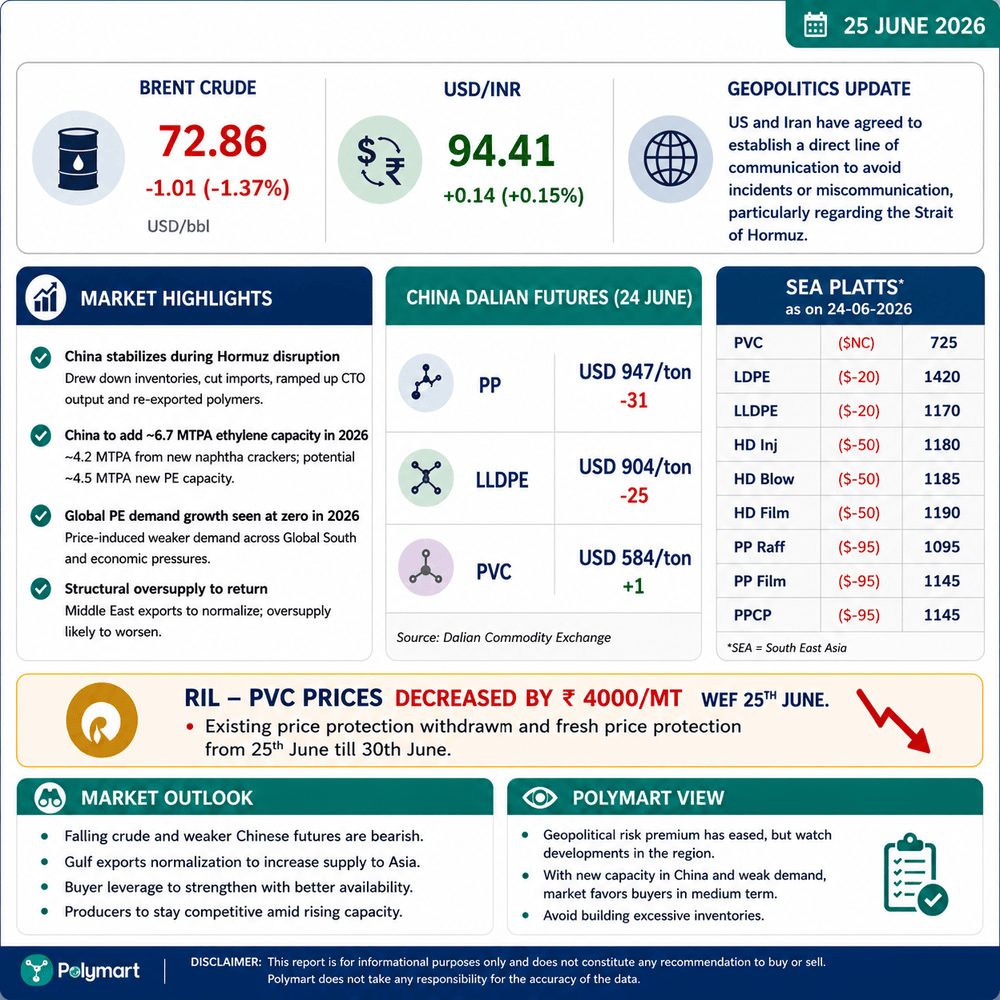
China Helped Stabilize Polymer Markets—But a Bigger Supply Wave Is Coming
China played a key role in stabilizing global polymer markets during the recent Strait of Hormuz disruption. Strong domestic inventories, lower imports, higher coal-to-olefins (CTO) production and selective polymer re-exports helped offset supply disruptions from the Middle East. However, the bigger story lies ahead. According to PetroChina International Planning & Engineering Institute, China is expected to add around 6.7 million tonnes/year of ethylene capacity in 2026, including 4.2 million tonnes/year from new naphtha crackers. Nearly 4.5 million tonnes/year of new polyethylene capacity could come online, further increasing global supply. At the same time, demand remains weak. Slower economic activity and price-driven demand destruction across emerging markets are expected to keep global polyethylene demand growth close to zero in 2026. With Middle Eastern exports gradually returning to normal, the market is expected to face another phase of structural oversupply, shifting bargaining power firmly toward buyers. Market Snapshot Brent Crude: USD 72.86/bbl ▼ 1.37%USD/INR: 94.41 China Dalian Futures (24 June) PP: USD 947/MT ▼31LLDPE: USD 904/MT ▼25PVC: USD 584/MT ▲1 SEA Platts (24 June) GradePVC USD 725/MT (NC)LDPE USD 1,420/MT ▼20 LLDPE USD 1,170/MT ▼20HDPE Injection USD 1,180/MT ▼50 HDPE Blow USD 1,185/MT ▼50HDPE Film USD 1,190/MT ▼50 PP Raffia USD 1,095/MT ▼95 PP Film USD 1,145/MT ▼95 PPCP USD 1,145/MT ▼95 Domestic Market Update - Reliance Industries (RIL) has reduced PVC prices by ₹4,000/MT with effect from 25 June 2026.- Existing price protection has been withdrawn.- Fresh price protection is applicable from 25 June to 30 June 2026. PolyMart Market View The easing geopolitical tensions have reduced the risk premium in crude oil, while softer Chinese futures and lower international polymer prices continue to indicate a bearish outlook for most commodity polymers. Historically, price corrections generally begin with PVC, followed by LLDPE, HDPE, and finally PP. Conversely, during an upcycle, PP usually leads the price increase, followed by HDPE, LLDPE, and lastly PVC. Although PP continues to remain relatively firm due to limited domestic and import availability, international PP prices have corrected sharply. As supply improves, domestic PP prices are expected to gradually align with global levels over the medium to long term. PolyMart Procurement Advisory - PVC is already witnessing price correction.- Further downside in LLDPE and HDPE appears likely.- PP remains comparatively firm in the short term due to supply constraints but could soften over the short-to-medium term.- Buyers should avoid unnecessary inventory accumulation and procure based on immediate production requirements while monitoring upcoming international price movements. Source: China Dalian Futures, SEA Platts, market intelligence, and publicly available geopolitical updates regarding the Strait of Hormuz. Disclaimer:PolyMart does not offer guarantees regarding the accuracy, reliability, or completeness of the information provided on its platform. Users are advised to independently verify any data before relying on it for decision-making purposes.