
In industrial sourcing and manufacturing, teams choose materials that deliver consistent performance, operational efficiency, and cost stability. Every material decision affects production flow, handling speed, storage life, and supply chain reliability. That’s when PP Rafia comes in.
PP raffia, also called polypropylene raffia, refers to a woven polypropylene material produced from flat tape yarns made of polypropylene resin. Manufacturers stretch and slit these tapes, then weave them into a structured fabric designed for high-load and repetitive industrial use. This production method gives PP raffia material the strength and flexibility without adding unnecessary weight or cost.
Industrial buyers value industrial-grade raffia because it performs predictably at scale. As a result, PP raffia industry use continues to grow in packaging, agriculture, construction, and textiles, where materials must handle stress, exposure, and frequent movement.
Here’s what the number says: The global polypropylene market is expected to grow from around USD 133 billion in 2024 to about USD 201 billion by 2033, expanding at a ~4.7 % CAGR.
If you are wondering, the PP raffia uses, PP raffia applications, and PP raffia industrial benefits, then keep on reading the full blog in detail.
Key Highlights
- PP raffia is a woven polypropylene material made from flat tapes, designed for industrial-grade applications that require strength, durability, and consistency.
- Industries use polypropylene raffia widely for packaging, agriculture, construction, textiles, and logistics due to its reliable performance under heavy-duty conditions.
- Businesses rely on PP raffia benefits such as cost efficiency, long service life, and adaptability across multiple industrial PP raffia applications.
What Is PP Raffia?
PP raffia is a woven polypropylene material made from flat plastic tapes produced using polypropylene resin. In simple terms, polypropylene raffia is a strong, lightweight, and durable material designed for industrial use.
Manufacturers stretch and weave these tapes to create PP raffia material that handles heavy loads, resists moisture and chemicals, and performs well in tough conditions. Because of these PP raffia properties, industries widely use industrial-grade raffia for packaging, agriculture, construction, and textiles.
In short, PP raffia is a cost-effective polypropylene solution used where strength, flexibility, and reliability matter.
Benefits of PP Raffia

Industries choose PP raffia because it delivers reliable performance, operational efficiency, and cost control across high-volume applications. The structure and polypropylene raffia composition give it advantages that directly support industrial and commercial use.
High Strength with Low Weight
PP raffia material offers excellent tensile strength while remaining lightweight. This strength-to-weight ratio allows industries to handle heavy loads without increasing transportation or handling costs. These PP raffia properties for heavy-duty applications make it ideal for bulk packaging and logistics.
Moisture and Chemical Resistance
Polypropylene raffia resists moisture, most chemicals, and solvents. This resistance protects packaged goods during storage, transport, and outdoor exposure. Because of this, many industries rely on PP raffia for industrial applications in agriculture, construction, and chemical packaging.
Consistent Quality and Performance
Manufacturers produce industrial-grade raffia under controlled processes, which ensures uniform thickness, strength, and weave. This consistency helps reduce product failure and material rejection in large-scale operations. These PP raffia industrial benefits matter most in automated and high-volume production environments.
Cost Efficiency at Scale
Industries benefit from PP raffia polymer features that support mass production at a competitive cost. Compared to natural fibers, PP raffia delivers longer service life and lower replacement frequency, which helps businesses control long-term material expenses.
Versatility Across Industries
Companies use PP raffia applications across multiple sectors without changing base material specifications. From PP raffia for agriculture and PP raffia for construction to PP raffia for textiles, the same material adapts to different industrial needs through weaving, coating, or lamination.
Durability in Harsh Environments
PP raffia properties include resistance to abrasion, repeated handling, and outdoor conditions. With UV stabilization, the material performs well under sunlight and weather exposure. These traits explain why industries use PP raffia in demanding operational settings.
Easy Handling and Processing
Woven polypropylene raffia allows easy cutting, stitching, printing, and lamination. This flexibility helps manufacturers customize products without complex processing steps, improving production efficiency and turnaround time.
Industrial Uses of Polypropylene Raffia
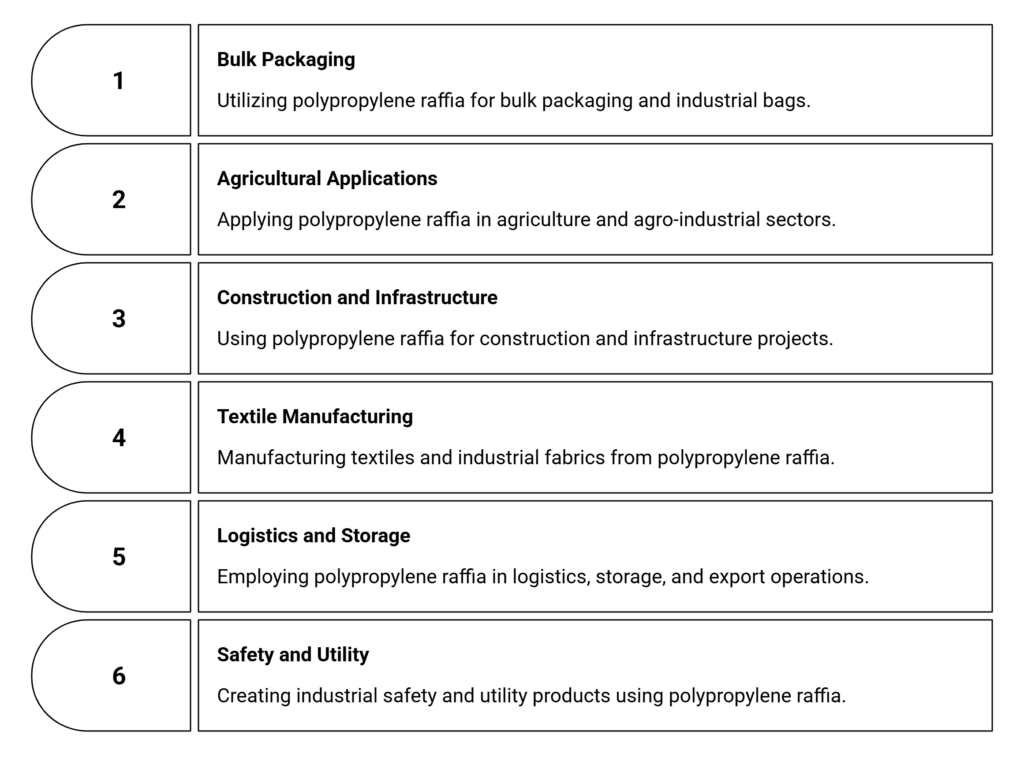
Industries use polypropylene raffia because it delivers strength, flexibility, and cost efficiency at scale. Manufacturers choose PP raffia for industrial applications where materials must handle load, friction, weather exposure, and repeated use without failure.
Below are the most common industrial uses of polypropylene raffia, explained from an operational perspective.
Bulk Packaging and Industrial Bags
The packaging industry relies heavily on PP raffia material to manufacture woven sacks, FIBCs, and bulk bags. Woven polypropylene raffia supports high tensile loads, resists tearing, and maintains shape during stacking and transport. Industries use industrial-grade raffia to package cement, fertilizers, chemicals, grains, polymers, and minerals, especially where long-distance logistics and export handling demand durability.
Agriculture and Agro-Industrial Applications
Companies widely use PP raffia for agriculture in applications such as fertilizer bags, seed packaging, crop covers, shade nets, and twines. The PP raffia properties, moisture resistance, UV stability (with additives), and lightweight handling help agricultural supply chains protect products during storage and field use. These PP raffia industry uses reduce spoilage while keeping packaging costs controlled.
Construction and Infrastructure
Construction suppliers depend on PP raffia for construction to package cement, sand, aggregates, and building materials. The material supports rough handling, heavy loads, and outdoor exposure at construction sites. Because PP raffia properties for heavy-duty applications include abrasion resistance and dimensional stability, builders and distributors trust it for consistent performance across projects.
Textile and Industrial Fabric Manufacturing
Textile manufacturers use PP raffia for textiles to produce mats, carpets, geotextiles, tarpaulins, and industrial fabric sheets. PP raffia polymer features allow easy weaving, coating, and lamination, which helps manufacturers customize products for specific industrial needs. Compared to natural fibers, polypropylene raffia delivers uniform quality and longer service life.
Logistics, Storage, and Export Operations
Logistics-driven industries choose PP raffia applications such as liners, covers, and wrapping materials to protect goods during storage and transit. Industrial PP raffia resists moisture, chemicals, and handling stress, which makes it suitable for warehouses, ports, and export packaging. These PP raffia industrial benefits help reduce product damage and packaging failures.
Industrial Safety and Utility Products
Manufacturers also use PP raffia material to produce ropes, webbings, safety nets, and strapping products. The PP raffia properties and benefits, lightweight strength, flexibility, and resistance to environmental factors support industrial safety standards without adding excess material cost.
To Wrap!
PP raffia continues to play a practical role in modern industries because it delivers what businesses actually need, strength, consistency, flexibility, and cost efficiency. From packaging and logistics to agriculture and construction, polypropylene raffia supports daily operations where materials must perform reliably under load, exposure, and repeated handling.
Its wide acceptance across sectors clearly explains why industries use PP raffia as a dependable, long-term material choice.
As industrial requirements grow more demanding, sourcing the right material from the right partner becomes just as important as understanding its properties. And, if you are looking for one, PolyMart is here to help. We are a leading polymer distribution company and you can buy PP raffia of the best quality and at best price with us.
Frequently Asked Questions(FAQs)
What is PP raffia used for?
PP raffia is used for woven sacks, bulk bags, industrial wrapping, tarpaulins, geotextiles, and packaging in agriculture, construction, and logistics.
How long does PP raffia last?
PP raffia material lasts for years in industrial use. UV-stabilised industrial PP raffia performs well even in outdoor conditions.
Is PP raffia suitable for industrial wrapping?
Yes. PP raffia for industrial wrapping offers high strength, flexibility, and moisture resistance for secure storage and transport.
What is the difference between raffia and polypropylene raffia?
Raffia is a natural fiber used for light-duty and decorative purposes. Polypropylene raffia (PP raffia) is a woven polypropylene material designed for industrial use, offering higher strength, moisture resistance, and durability.
What are PP raffia properties for heavy-duty applications?
PP raffia properties for heavy-duty applications include high tensile strength, resistance to moisture and chemicals, abrasion resistance, lightweight structure, and long service life, making industrial PP raffia suitable for demanding industrial environments.